More info
Journey
How did your CEMS experience shape your international path - and what led you to move from consulting and entrepreneurship to AI safety?
Without my CEMS studies I would not be in AI Safety today. I would have probably gone straight into consulting or worked at a startup.
CEMS allowed me to attend two excellent institutions, RSM and SSE, while giving me the freedom to explore my passions - in this case AI safety.
I remember sitting in the RSM library doing volunteer research work for The Future Of Humanity Institute in late 2016, working on the research question of “which historical precedent exists for ‘safe-making’ technology to be accelerated in development vis-a-vis risk creating technology?” - a question that some readers here may find interesting also today, as we see AI accelerate to a degree which was commonly seen as further in the future back in 2016. I also wrote a first publication on the topic at a CEMS friend’s home, which eventually landed me a spot in an AI Safety Research camp post graduation. My RSM friends even gifted me a version of Max Tegmark’s Life 3.0 as a birthday gift - a person I admired and who I have since had the (still somewhat surreal) pleasure of interacting and collaborating with.
During my time at SSE, I both got to attend a talk by an FHI fellow and met someone, through a CEMS friend, who ‘stayed’ in the AI safety community and helped me launch what is now the AI safety organziation I run, The AI Whistleblower Initiative.
Why did I not move into AI safety straight away? Simply put: I had different timelines and I believed my management education would come in handy further down the line, once things moved from theory to practice, which I believe is more the case now. Solving problems with people, thinking about building organizations and solutions from scratch is a great skill to have, which I wanted to build through consulting and my own startup first.
Purpose
You often refer to curiosity, compassion and courage as guiding values. How did these values lead you to found the AI Whistleblower Initiative?
Curiosity: As it looks right now, AI is the greatest opportunity and challenge in the history of humanity. I genuinely believe we happen to live in the most exciting and transformational times ever (ever). I am deeply interested in how it will continue to develop, what it’s implications are, and how we can shape it. I also really want to know what is happening within AI companies to form accurate views on best next steps. Finding innovative ways to help insiders, if required, also requires a hefty dose of creativity.
Compassion: I care about supporting people doing “the right thing”.
Courage: We as a society should support individuals who have the courage to stand up for what they think is right, also in the face of adversity. It just seems fitting that I hold myself to the same standard: Starting a non-profit, including the personal financial opportunity cost, is one thing. Doing it in ‘whistleblowing’, a space that doesn’t look incredibly attractive for a future potential employer, is another. To be clear, though: This was not a difficult choice for me. I want to be able to look at my hypothetical grandchildren in a few decades and say, “I did my best to make this transition go well”.
Impact
Through aiwi.org, you support individuals raising concerns at the frontier of AI. What impact are you most proud of so far?
We were deeply involved with getting the EU AI Office to launch the first global whistleblowing channel specifically for AI insiders, staffed with experts and with strong confidentiality provisions, allowing also insiders from abroad to raise concerns. No channel like this existed globally to date - now it does. This should be both a) directly helpful and b) set precedent for the US.
Looking Ahead
As AI accelerates, what responsibilities do globally trained leaders, including CEMS graduates, carry today?
Take it seriously. Be aware that AI risk can be heavily skewed towards tail distributions: There’s some chance that things will get very, very weird over the next 5-10 years. This does not mean “live in fear paralysis”: An awesome horizon awaits, you can help us get there: As much as risk might be tail-distributed, marginal contributions to positive outcomes might outweigh many alternatives you have to shape the trajectory of your life. If you’re considering getting involved - <10,000 people globally are working on this challenge. Managerial, growth, people talent is in very short supply. Message me if you’d like to to explore the topic: karl.koch@aiwi.org.
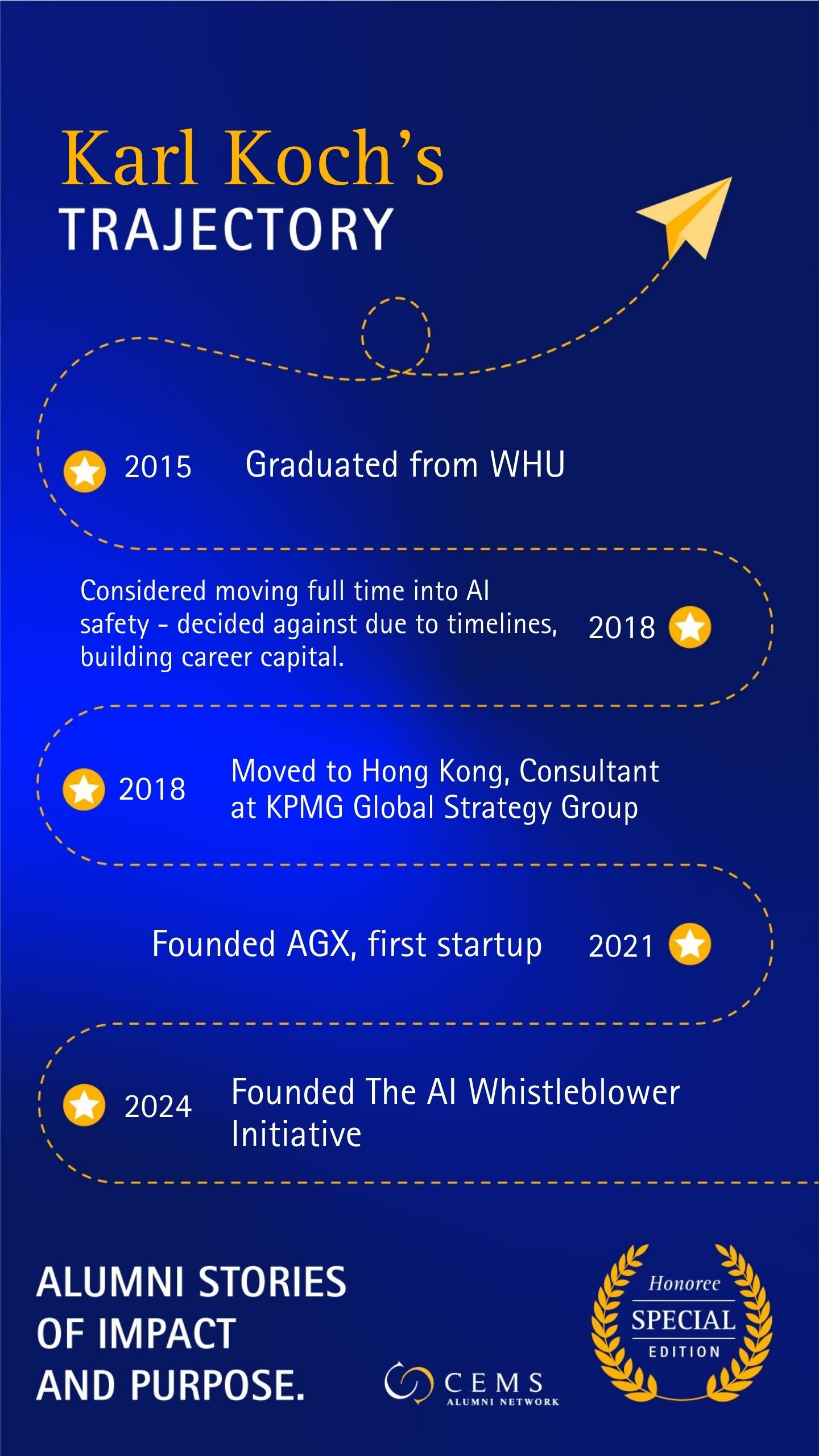
Karl's Trajectory: 5 Key Moments
In Five Insights – Leadership Takeaways
- One defining decision - Launch AIWI.org
- One risk that changed everything - Take the risk to follow passions - some day you’ll be the only person with a unique combination of knowledge and skills that is needed - and it’ll combine all you want.
- One failure that taught you something important - I did an internship at Bain and did not get a return offer. I had wanted this internship a lot, realizing it wasn’t a fit for me.
- One belief that shapes leadership - Think of ‘why’.
- One piece of advice to future global leaders - Some thoughts that help me: At the start, you have nothing to lose. As you progress, things only get easier.