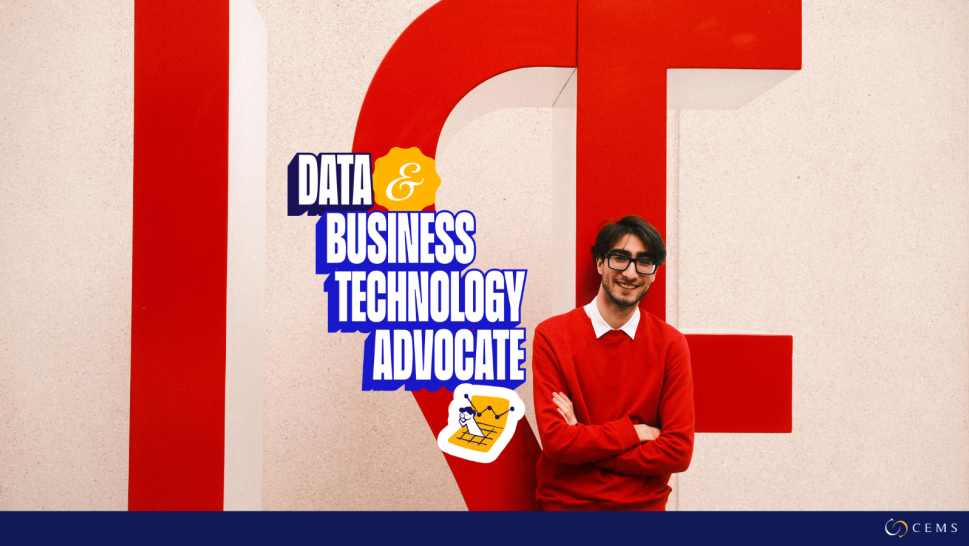
I grew up in Adana, in the south of Turkey, and moved to Istanbul to study Mechanical Engineering and Business Administration at Koç University. Engineering shaped my brain, but business was always in my blood: my family runs a company, and I added a double major in business administration because I knew, one day, I wanted to build something of my own. At the end of my bachelor's, one of my engineering professors told me about CEMS. His daughter had done the programme, and he was convinced it was made for someone like me. He was right. I chose LSE, The London School of Economics and Political Science, as my exchange school, the city where my grandfather had earned his own master's decades earlier.
The first weeks tested me in a way I did not anticipate. In engineering, you move only when you are certain; if there is even a small chance of failure, you do not take it. In my first block seminar at LSE, people were raising their hands and proposing answers without being sure at all, and I froze. Should I speak up when I might be wrong? I asked our programme manager at LSE, and her answer changed my semester: this is your school too, do not classify yourself as an exchange student, you are an LSE student. So I started engaging, and I learned the rule business minds live by: nobody is ever a hundred percent right, and waiting for certainty is often the most expensive decision of all.
Regardless of your background, this programme will find a place for you. You don't even know yet what you'll succeed at.
What followed was a crash course in turning analysis into something people can act on. I knew how to study, but I had no consulting background, and I did not know how to build a deck that carries an argument. A friend at LSE, Louis Balleston, sat with me in our dorm lobby for two hours and showed me how: structuring a slide, choosing the right visual, making each point land. It sounds small. It is not. Communicating data convincingly is half the work, and I learned it from instructors and friends alike.
Turning thousands of data points into one decision
The CEMS Business Project brought everything together. My team worked with Beko, a CEMS Corporate Partner, on understanding how customers experienced their app. The raw material was thousands of reviews, far too many to read one by one, so I used AI to detect patterns in the noise and shape the findings into a single recommendation the client could actually use. Data analysis on one side, stakeholder communication on the other: that is the skill CEMS builds, and the curriculum backs it with mandatory data analytics courses. Technology stopped being a subject I studied and became a daily working ally.
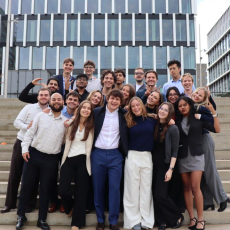
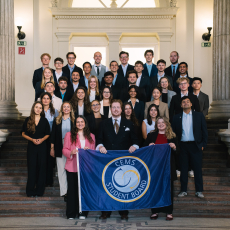
CEMS also gave me a community I now help lead, as president of the CEMS Club Istanbul. At Koç we are a small group of CEMS students, and hosting the cohort here changed my relationship with my own country: my international friends wanted to see everything, and with them I travelled further across Turkey than I ever had alone. In London, the logic was the same in reverse, with our group exploring a different culture every week, one restaurant at a time. My best friend Emre and I still talk daily with our CEMS friends spread across the world, and being introduced somewhere as "Mert's friend" has become a passport of its own.
From engineer to data & business technology advocate
To future students who do not come from a business background, here is what I tell them: do not be frightened. In every group project I did, the team mixed completely different profiles, and everyone found their place and delivered. CEMS will find yours too. I arrived as an engineer who needed certainty before moving. I am leaving as a data and business technology advocate: someone who gets the evidence, trusts the analysis, communicates it clearly, and decides. And somewhere along the way, I unlocked braver parts of myself I did not know were there.