The report argues that this moment provides a rare opportunity for graduates and employers alike. AI-fluent Graduates can be advocates for new technology and evidence-based problem-solvers who can help drive change across companies, at a time when in-house experience is still scarce.
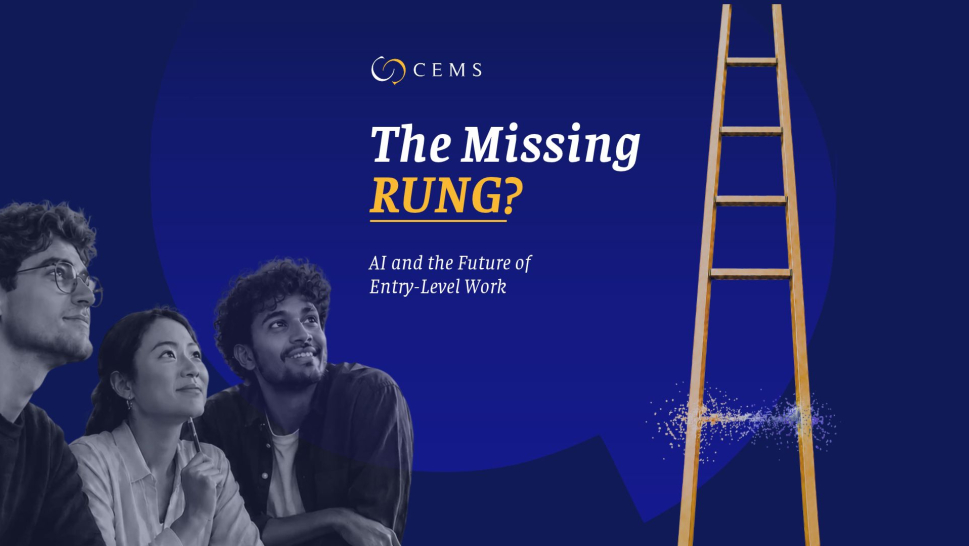
The report, The Missing Rung? AI and the Future of Entry-Level Work, draws on interviews and research with students in more than 20 countries, alongside contributions from senior corporate partners (global multinational companies) and expert academics across the CEMS alliance.
According to report contributors, entry-level recruitment is where companies grow the leaders they will rely on for decades to come. Graduates hired today are the senior leaders of tomorrow, developing the judgement, responsibility and independent thinking that no organisation can shortcut.
Nicole de Fontaines, Executive Director of CEMS, said:
“Entry-level roles are far more than a way of getting work done. They are where young people learn judgement, responsibility and how to lead across cultures, and where a company’s values are passed from one generation to the next.
“Companies that continue to hire and develop graduates are not simply filling vacancies. They are investing in the people, and the culture, on which their long-term success depends. Responsible, innovative, globally minded future leaders are not hired ready-made. They are grown, through the real-world experience that entry-level roles provide.
Frank Steinert, Global Head of HR Regions at Henkel, a CEMS corporate partner, writes in the report:
“If you go to the extreme and say you are not hiring entry-level positions, you may have created a significant risk for future growth. A few years down the road, the natural progression of your leadership pipeline breaks down, and that also damages the company culture you built up diligently over years or decades.”
Gianmarco Mazzocchi and Merthe Weusthuis, CEMS alumni at corporate partner Whiteshield, write in the report:
“Many companies have been too aggressive in their plans to replace employees with AI tools, and the real cost is starting to show. Continuing to hire graduates is crucial for the leadership pipeline. Our leaders have nearly always come up through the ranks - people you can gradually build into exceptional managers and senior leaders, particularly coming straight from university.”
The bottom rung of the ladder is changing, not disappearing
Despite widespread global fears around graduate roles being replaced by AI, contributors to the report argue that in most cases the bottom rung of the career ladder is not missing, it is changing shape. Routine drafting, data pulls and first-pass analysis are being absorbed into AI-managed workflows, but new roles are forming around them.
This supports data from CEMS’s corporate partners which contradict some of the more doom-laden predictions about AI and graduate jobs. Gartner data shows fewer than 1 percent of the 1.4 million layoffs recorded in 2025 were attributable to AI productivity gains, while Bain & Company found AI-related job postings have grown 21 percent a year since 2019.
Other key findings:
- AI is a golden window for graduates, not a lost opportunity: nobody has a decade of experience with today’s AI tools, so motivated graduates can become a team’s go-to expert within months rather than years.
- Graduates must put in the work: doing the minimum is not enough to secure a graduate role, as using AI is now the baseline. Graduates who stand out will be able to prove they are a “Builder” who can stitch AI tools into something that works end-to-end, a working demo, a personal project or a mock start-up.
- Identity and judgement will be differentiators: a strong sense of self, built through real-world experiences with genuine stakes such as sport, travel or volunteering, is what will enable graduates to use AI ethically, develop resilience, and stand out in a job market saturated with AI-generated sameness.
- Business schools and universities must embrace AI: rather than restricting AI, educators should embed it firmly into teaching and assessment, whilst redesigning coursework so that each student’s own reasoning and judgement remain visible. Partnerships with industry will be vital to stay ahead of the latest technological developments, as the business world moves faster than the academic calendar.