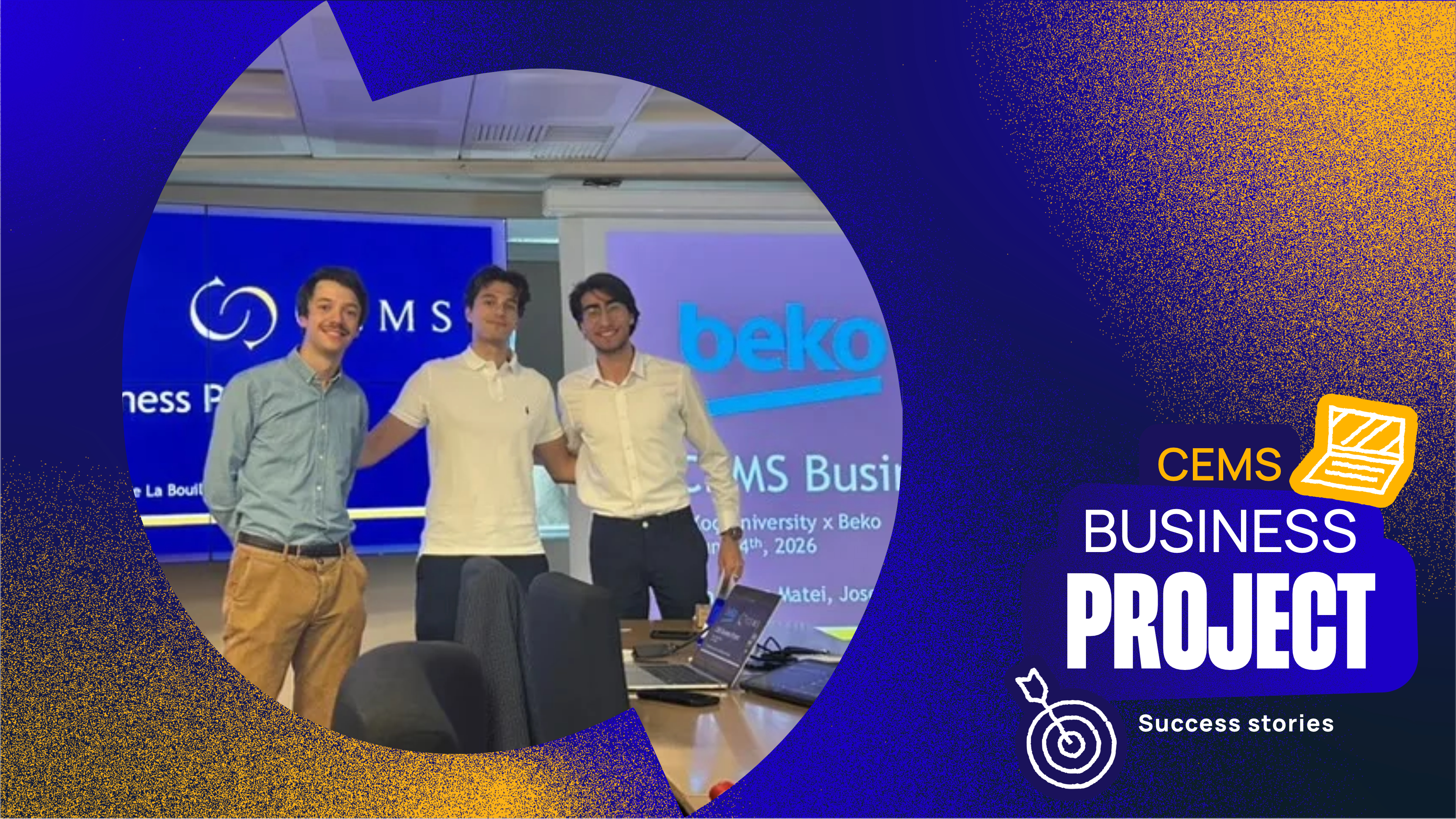
Beko, one of the largest home appliances companies worldwide, was looking for a fresh external perspective on three priorities already high on its strategic agenda: premium positioning, connected products, and how new products are brought to market. The challenge for the CEMS team was to connect the three into one coherent strategy.
The project brought together three CEMSies at Koç University, each bringing a different academic and international perspective: Christian Matei (Nova SBE), Mert Güneyli (Koç University) and Joseph Roullet de la Bouillerie (HEC Paris).
With academic guidance from Dr. Melike Mermercioglu at Koç University, they worked closely with Beko’s strategy team over the spring of 2026, including Sercan Şafak, Head of M&A and Strategic Planning at Beko and Arif Emre Keleş, Executive Director of Strategy.
For Sercan, himself a CEMS graduate from Koç University and LSE, the value of the collaboration lies partly in bringing an outside perspective to questions the company is already exploring.
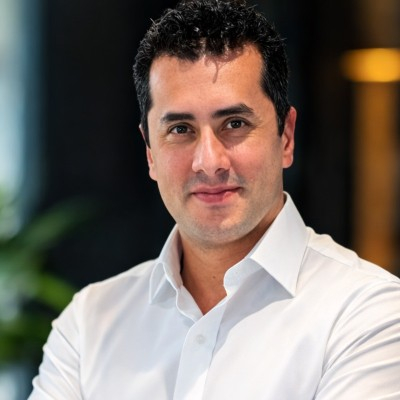
“The students always approach the topic with a high level of curiosity, analytical rigor, and creativity, often challenging established assumptions and helping us look at the issue from different angles. ”
Sercan Şafak, Head of M&A and Strategic Planning at Beko
Turning three workstreams into one strategy
The scale of the assignment could easily have resulted in three separate pieces of work. Instead, the students brought the strands together into one integrated strategy.
For Arif Emre Keleş, Executive Director of Strategy at Arçelik/Beko, this is also what gives the Business Projects their longer-term value: the topics are closely connected to the company’s strategic priorities, so the strongest recommendations can feed directly into business discussions.
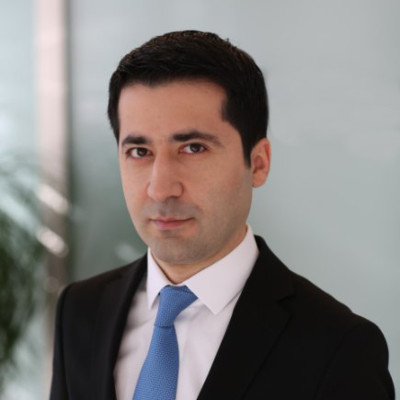
“We choose CEMS Business Project topics very carefully so they address priorities that matter to the business. What makes the collaboration particularly valuable is the combination of a fresh, international perspective with recommendations that can feed directly into our strategic discussions and decision-making. ”
Arif Emre Keleş, Executive Director of Strategy, Arçelik/Beko
For Dr. Melike Mermercioglu at Koç, this ability to bring the three workstreams together into a coherent proposal was one of the strengths of the project.
Their analysis resulted in a 154-page report, combining consumer research, competitor benchmarking and detailed analysis of five European markets. Rather than assuming that premium means the same thing everywhere, they looked at how customer expectations, willingness to pay and brand perceptions varied between Germany, France, Italy, Spain and Poland. As CEMS Student Mert Güneyli explains, the team “went through thousands of customer reviews and used AI to spot the patterns, turning all that noise into a clear recommendation.”
One finding became particularly important: premium value is not necessarily created by adding more features, but by focusing on the attributes customers value most.
The team’s research pointed to durability, reliability, energy efficiency and ease of use as particularly strong drivers.
Reaching a conclusion, then defending it
The team’s international make-up also helped throughout the project, giving them access to different markets, sources and perspectives, from Turkish retail environments to German and French consumer insights.
For CEMS student Christian Matei, this was precisely what made the challenge so interesting: “How do you build a premium feeling for a brand? In home appliances, a brand tends to be seen as premium or not, and making that shift is something I had rarely seen done” he says.
The same customer-first logic shaped the team’s work on connected products. Their analysis suggested that connected features create the greatest value when they respond to a clear consumer need and deliver a reliable, intuitive experience.
But for Christian, one of the most valuable moments came when the team presented its recommendations at Beko’s Türkiye headquarters, in front of the strategy department. During the discussion, a Beko strategy lead challenged one of the team’s own data points with a simple question: "You, as a German, would you act the same way?"
The exchange stayed with him. It showed that strong analysis was not simply about producing data, but about interpreting it, questioning it and being ready to defend - or refine - a recommendation when challenged.
Where the coursework ends and the job begins
The final presentation took place at Beko’s Türkiye headquarters, in front of the whole strategy department. According to Beko, the project went further than initially expected, both in the depth of the analysis and the level of detail of the recommendations.
For Christian, the experience was different in scale and depth from a conventional course. It meant taking a position, presenting it to a real client and learning how to respond when that position was questioned.
“I came out of it more sure of my own judgment, and clearer about where I’m heading. It confirmed that consulting is the direction I want to take.”