About the Event
Global supply chains today operate in an environment where geopolitical risk has become a structural factor shaping strategy and operational continuity. Armed conflicts, export controls, tariff disputes, and regional tensions are no longer peripheral disruptions; they function as systemic risk drivers that affect industries and markets far beyond their geographic origin.
At the same time, globalisation itself is being recalibrated under geopolitical realities. Rather than a continued expansion of frictionless global integration, we observe a strategic shift toward regionalisation and localised supply structures. This does not imply the end of global supply chains, but it requires organisations to rethink globality: balancing international networks with regional resilience, redefining sourcing footprints, and reassessing dependencies on critical regions and suppliers.
In this context, the human dimension is becoming increasingly critical, and the competencies of employees such as analytical skills, technological literacy, cross-functional collaboration, and geopolitical awareness are emerging as decisive success factors. In this regard, the “Future of Work” in supply chain management raises a central question: What roles will people assume in increasingly digital, data-driven, and automated supply networks? Rather than focusing on isolated disruption events, this perspective highlights the structural transformation of supply chains: redesigning planning and sourcing models, integrating artificial intelligence into decision-making processes, and developing the organisational and human capabilities required to operate effectively under persistent geopolitical uncertainty.
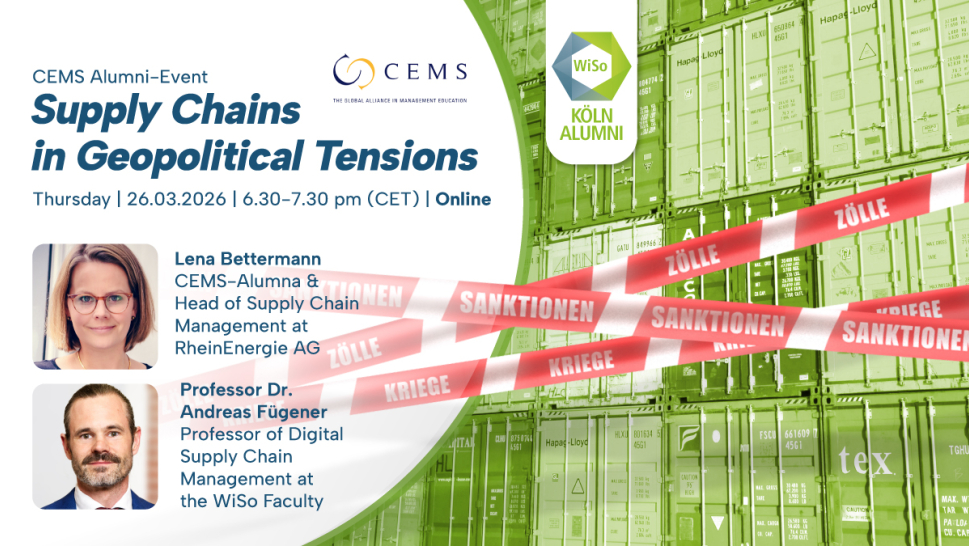
In our online event “Supply Chains in Geopolitical Tensions“, together with UoC CEMS alumna Lena Bettermann, Head of Supply Chain Management at RheinEnergie AG, and Dr Andreas Fügener, Professor for Digital Supply Chain Management at the Faculty of Management, Economics and Social Sciences at the University of Cologne, we aim to explore these developments. The discussion will provide practical insights into how organisations can design resilient, adaptive supply chain strategies that mitigate geopolitical risk, strengthen organisational capabilities, and position themselves competitively in an increasingly fragmented global economy.
Course of the event
- 6.30 pm Welcome address: Brief introduction of the experts
- 6.35 pm Expert Dialogue: Lena Bettermann, Head of Supply Chain Management at RheinEnergie AG & Dr Andreas Fügener, Professor of Digital Supply Chain Management at the WiSo Faculty
- 7.15 pm Q&A and discussion
- 7.25 pm Outlook, closing remarks & farewell
- 7.30 pm End of the event
Meet Our Speakers
Lena Bettermann is a Supply Chain Management leader with extensive experience in strategic sourcing, business transformation, and project steering. She holds a Diploma in Business Administration from the WiSo Faculty, with terms abroad in Singapore and Norway during her CEMS studies. After starting her career at Accenture, she held senior procurement and supply chain management roles at Unitymedia, Vodafone, and Vantage Towers. Since 2025, she has been Head of Supply Chain Management at RheinEnergie AG, responsible for procurement and logistics.
Andreas Fügener is Professor of Digital Supply Chain Management at the WiSo Faculty of the University of Cplogne since 2019. Previously, he was Postdoctoral Researcher at the University of Augsburg (2013–2016). He earned his PhD in Operations Management from TUM, where he also worked as Research Assistant. Alongside academia, he was Consultant at BCG. His research focuses on Supply Chain Management, Health Care Operations, and Behavioral Project Management.