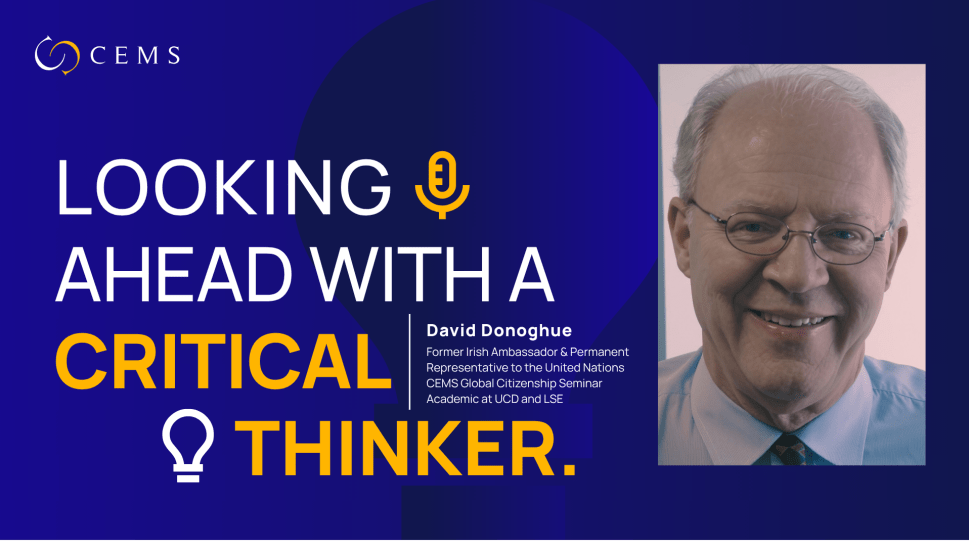
Listen to the Podcast
This episode features David Donoghue. David Donoghue has had a long and distinguished career in Ireland's Department of Foreign Affairs, serving as ambassador to Russia, Austria and Germany. He was one of the Irish government's chief negotiators for the historic Good Friday Agreement, which brought peace to Northern Ireland in 1998.
Ambassador Donoghue was also Ireland's permanent representative to the United Nations, where he co-chaired negotiations in 2015 that led to global agreement on the UN Sustainable Development Goals and the 2030 Agenda for Sustainable Development. Today, he is actively involved in think tanks that address the challenges of development, migration and conflict resolution. David also teaches the CEMS Global Citizenship Seminar at LSE and University College Dublin, in which sustainability and the UN SDGs remain central themes.
There can be no agreement till everyone sees themselves in it.
David Donoghue has first-hand insights here. A former Irish ambassador and permanent representative to the United Nations, he was part of the team that brokered peace in Northern Ireland through the Good Friday Agreement in 1998. In 2015, he co-chaired the negotiations that led to the UN Sustainable Development Goals and the 2030 Agenda. Today, he is actively involved in think tanks focused on development, migration and conflict resolution. He also teaches the CEMS Global Citizenship Seminar at LSE and University College Dublin.
In this first episode of Looking Ahead: Conversations with CEMS Critical Thinkers, Donoghue reflects on ambition, compromise and the often-intractable work of building consensus among multiple stakeholders.
He argues that circumstances – rather than misplaced optimism – account for disappointing progress towards the UN’s SDGs. While the goals were deliberately designed to stretch and challenge governments and societies, the pandemic, geopolitical conflicts, tensions and economic contraction have seen countries double down – but not abandon their ambition. Getting us over the finish line now, however, means changing the way institutions and organisations think and work. Specifically, the imperatives ahead for decision-makers include:
- Breaking out of silos. Solving complex problems hinges on aligning efforts across the environment, health, education, inequality and development, rather than treating them as separate issues.
- Accepting complexity. Different priorities and interests will collide, making complex solutions and trade-offs an inevitable part of progress.
- Keeping the faith. Even when things feel polarised or fragmented, collective action must remain the chief imperative if we are to find solutions to global challenges.
- Learning the lessons. One of the most critical lessons from the Northern Irish peace process is that there are no winners or losers – everyone has to be a winner if solutions are to endure.
- Bringing business into the equation. Governments cannot deliver solutions alone, and development will generate new opportunities and markets. Business organisations have a crucial role to play in generating, driving and sustaining momentum.
CEMS students should provide a source of optimism, says Donoghue. In his experience teaching future leaders from around the world, he has seen no retreat from the idealism that underpins the UN SDGs. Young people, he argues, constitute a “motor” for positive change: a generation for whom climate change, pandemics, social, economic and gender inequality, and conflict are shared challenges that demand urgent and collective solutions.
Whether it is bringing divided communities together in the pursuit of peace or convincing 193 countries to sign up to a common agenda, progress hinges on finding new ways for different interests to coexist within a shared purpose. As Donoghue says "there is no agreement until everyone can see themselves in it."